Overview
Recent advances in generative AI have collapsed the cost of software development, enabling a new generation of tools, such as Lovable, v0, and Bolt, that let anyone build an application through natural language to fit their own needs. The longstanding HCI challenge of letting people without design or coding skill create interactive systems therefore shifts from one of development to one of design. Accounts of design theory, both iterative and reflective, traditionally assume a trained designer refining a stable artifact of their own making, where each change is local and reflects the author's intent. In a generative tool, each of these conditions takes a different form. (i) The user's request operates at a different level of abstraction than the code it changes, so the resulting change is non-local, a structural property of the generative medium. (ii) The change is produced by the model, so it contingently reflects the model's reading as much as the author's intent. (iii) The designer's knowledge, the work of deciding what the interface should contain, how it should be arranged, how it looks and behaves, and whether it serves what the person set out to do, is shared between the model and the user.
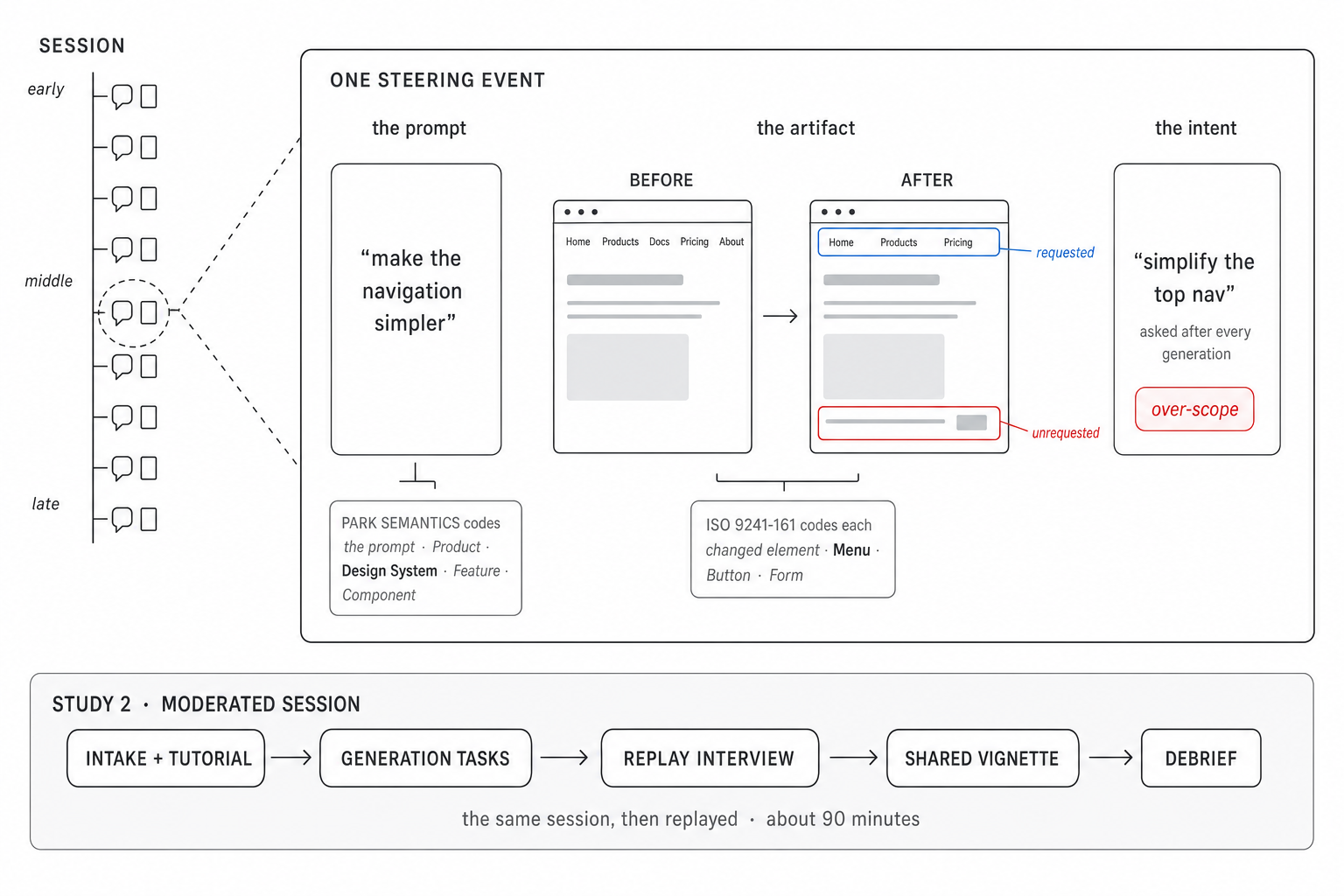
To trace how far these accounts extend into this new setting, and where the generative medium requires revisiting them, we built Mark, a custom AI-assisted prototyping web application that reproduces the core features of commercial tools. We recruit 100 users without design or development expertise and task them with building and revising prototypes. We give each participant three tasks: a from-scratch brief in a domain held constant across participants and outside their expertise (T1); a modification task on a shared starting artifact (T2); and a from-scratch brief generated on the fly within the participant's own domain of expertise (T3). We map each prompt onto an established taxonomy of UI prototyping prompts and each interface diff onto a standard taxonomy of interface elements. We analyze how the relationship between the prompt and the interface unfolds, where and how far the generated artifact moves beyond what the prompt asked, and how this depends on the level of the prompt and the kind of element changed (RQ1). We trace whether the result matches the user's request, how users recover when it does not, and what becomes of the changes the user never requested (RQ2). Comparing T1 and T3, we measure how domain expertise shapes the way users steer the model (RQ3). Study 1 collects a behavioral record, which allows us to measure how sessions unfold at scale, but does not show what participants noticed in a generation, why they chose a recovery move, or when they judged the result done. In a second, moderated study, ten non-experts from the same population complete the same three tasks and then review a replay of their own session, reconstructing what they were noticing and deciding at moments selected from the log by fixed rules. Through this reconstruction we recover the reasoning behind the behavior that Study 1 records. Additionally, we recruit ten trained designers to complete the identical protocol, letting us compare how designers and end users read, judge, and steer generation (RQ3). Together, the two studies give the anatomy of a generative prototyping session.
Research Questions
What does an iteration session in a generative UI tool look like as a sequence of steering events, and what does that tell us about how iterative design works under this paradigm?
- RQ1 How does the relationship between a prompt and the resulting interface unfold, including where and how far the generated artifact moves beyond what the prompt asked, and how this depends on the level of the prompt and the kind of element changed?
- RQ2 Does the generated result match the user's request, how do users recover when it does not, and what becomes of the changes the user never requested?
- RQ3 How does expertise shape the way people read, judge, and steer generation, across both domain expertise (Study 1) and design training (Study 2)?
Studies
Each participant works on three short interface-building briefs in the custom generative UI application. Two briefs are from-scratch and one is a modification of an existing interface, with the order of the two from-scratch briefs counterbalanced across participants. After every generation the application asks one short question describing what the participant was trying to change. Prompts, before and after artifact snapshots, generated code, diffs, and intent notes are logged event by event.
Analysis combines structural diffing of the generated artifact with LLM-assisted semantic coding along two axes: prompt semantics (Park's Product / Design System / Feature / Component) and granular UI element (ISO 9241-161). A stratified subsample is human-coded for inter-rater reliability before the LLM pipeline runs on the full dataset.
Hypotheses
Five confirmatory hypotheses are registered, each with a directional prediction and a pre-specified test.
- H1. Generations change more of the interface than the prompt asked, beyond what a same-prompt chance baseline produces.
- H2a. Misalignment becomes more likely as the prompt sits at a higher level of abstraction.
- H2b. Stating a single intention also costs more words at higher levels of abstraction.
- H3. After a misaligned generation, re-stating the same request is more common than moving down a level or changing direction.
- H4. Participants steer differently inside their own domain than outside it, measured across the two from-scratch briefs.
One further contrast is registered as an estimate rather than a test: how far designers and non-experts differ in the size and depth of the changes they realize in the modification task. A separate exploratory layer is pre-registered alongside these hypotheses.
Each participant completes the same three tasks as Study 1, in the same application and with the same logging. Immediately afterwards the session is replayed. At seven or eight moments selected from the log by fixed rules, participants first say what they remember and then see what actually happened. A final vignette, identical for everyone, shows the same cascade event to all twenty participants and gives the two groups one directly comparable observation. Designers are screened on their current role, at least two years of paid practice, and a verified portfolio.
The questions
Each replay probe resolves something the Study 1 log records but cannot interpret, and together they follow the life of one steering event, from the intent that precedes the first prompt to the decision to stop.
- Before typing, how much of what participants wanted never reached the prompt at all? (RQ1)
- When the generation arrived, did they see the changes they never asked for, or did those changes pass unnoticed? (RQ2)
- After a failed request, what did they think had gone wrong, and what options did they feel they had? (RQ2)
- When they built on an element the model introduced, had it earned its place or was it simply already there? (RQ2)
- When they stopped, was the prototype done or the best they expected to get? (RQ2)
- Looking at the identical vignette, what does design training let a participant see and propose? (RQ3)
- Do the intent notes and alignment labels of Study 1 match what participants say they actually meant?
Phases tracked in the Experiment modal:
- Phase 1. Welcome, consent, intake questionnaire, and the tutorial (≈ 15 min).
- Phase 2. Generation session, three tasks back-to-back (≈ 40 min).
- Phase 3. Replay interview over the participant's own session, closed by the shared vignette (≈ 30 min).
- Phase 4. Debrief and compensation (≈ 5 min).
Project Timeline
Participants (Study 2)
Participants who submit the moderated-session screening appear here. Click a name to see screening details. Use the Experiment button to run a moderated session with the phase timer and notes. Study 1 participants come through Prolific and do not appear in this table.
Links
Public hub with Study 1 and Study 2 entry points and their screenings.
The custom application participants use during a session — Mark.
Pre-registered hypotheses and analysis plan. Linked once locked.
Protocol, observation sheet, and shared study artifacts.